Doing Church Together

A library, field guide, and the theology underneath.

Start Exploring
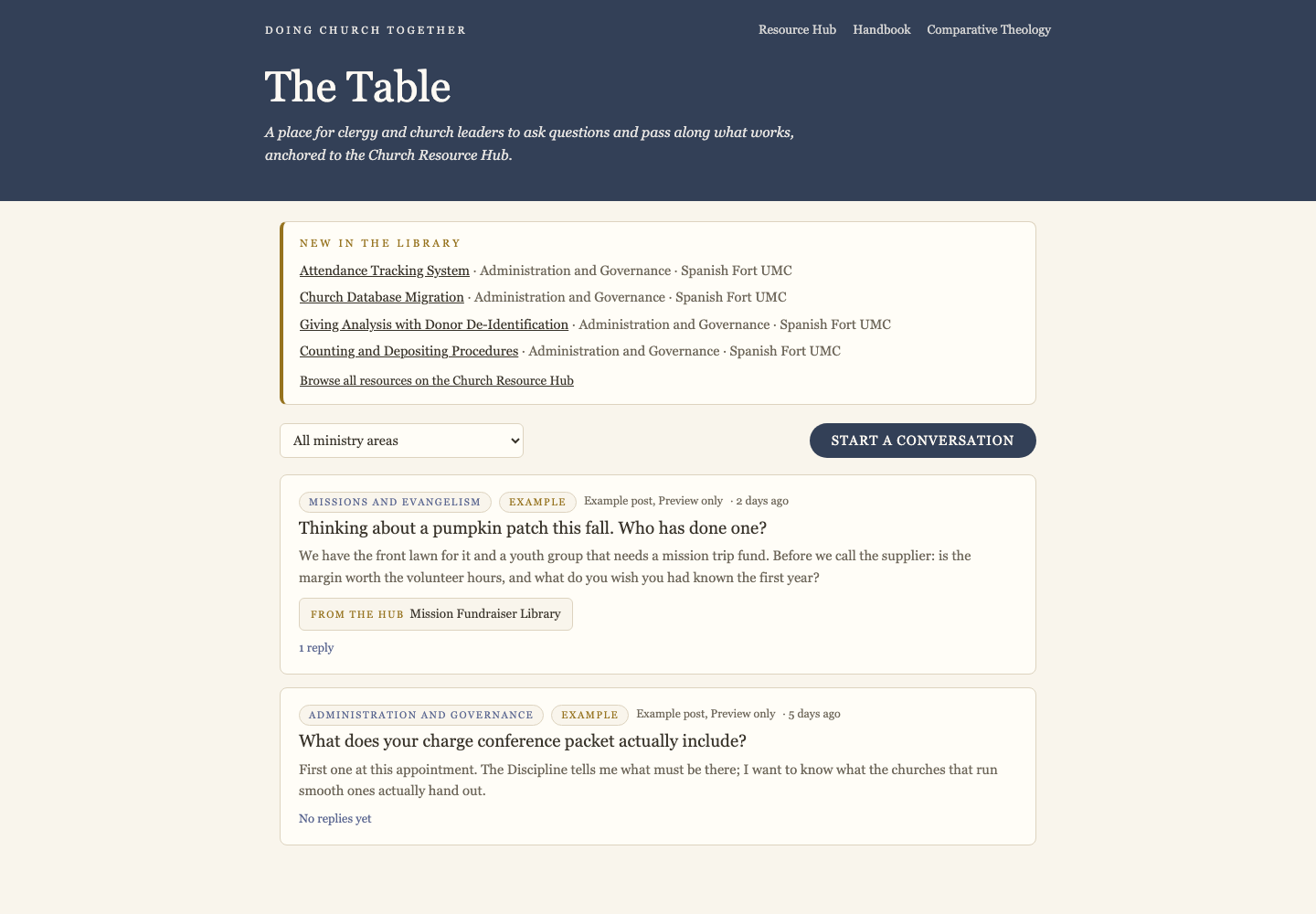
The Church Resource Hub: a searchable library of real church documents on a warm paper background. The ToolboxThe Church Resource Hub The Pastor's Handbook: the contents panel beside an open chapter on the Pastor's Triangle. The MapThe Pastor's Handbook Theology and Practice: an interactive map of 23 connected doctrines with an Ask assistant. The ThinkingTheology and Practice Comparative Theology: the Christian traditions plotted on a two-axis map of what they believe. The CompassComparative Theology
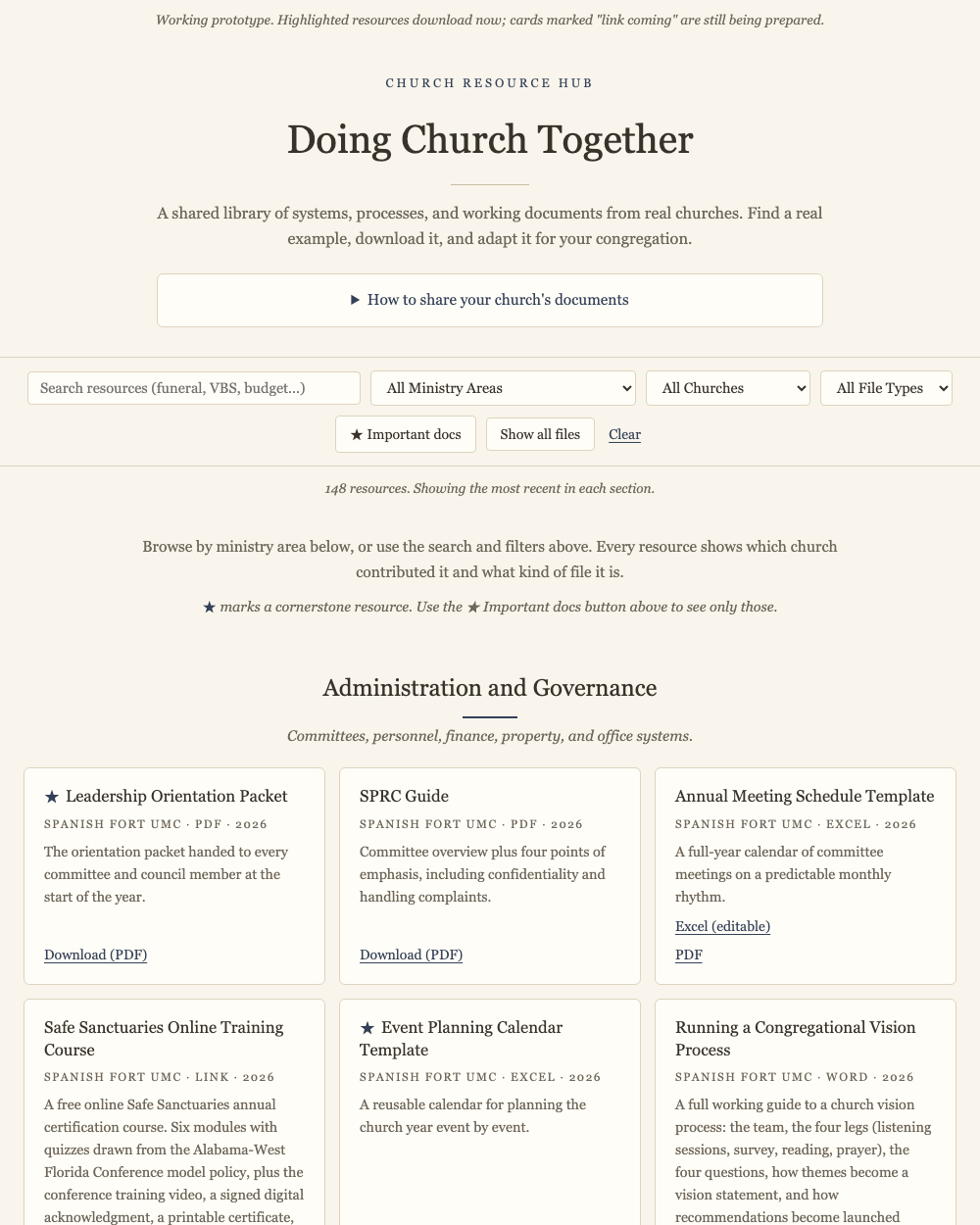
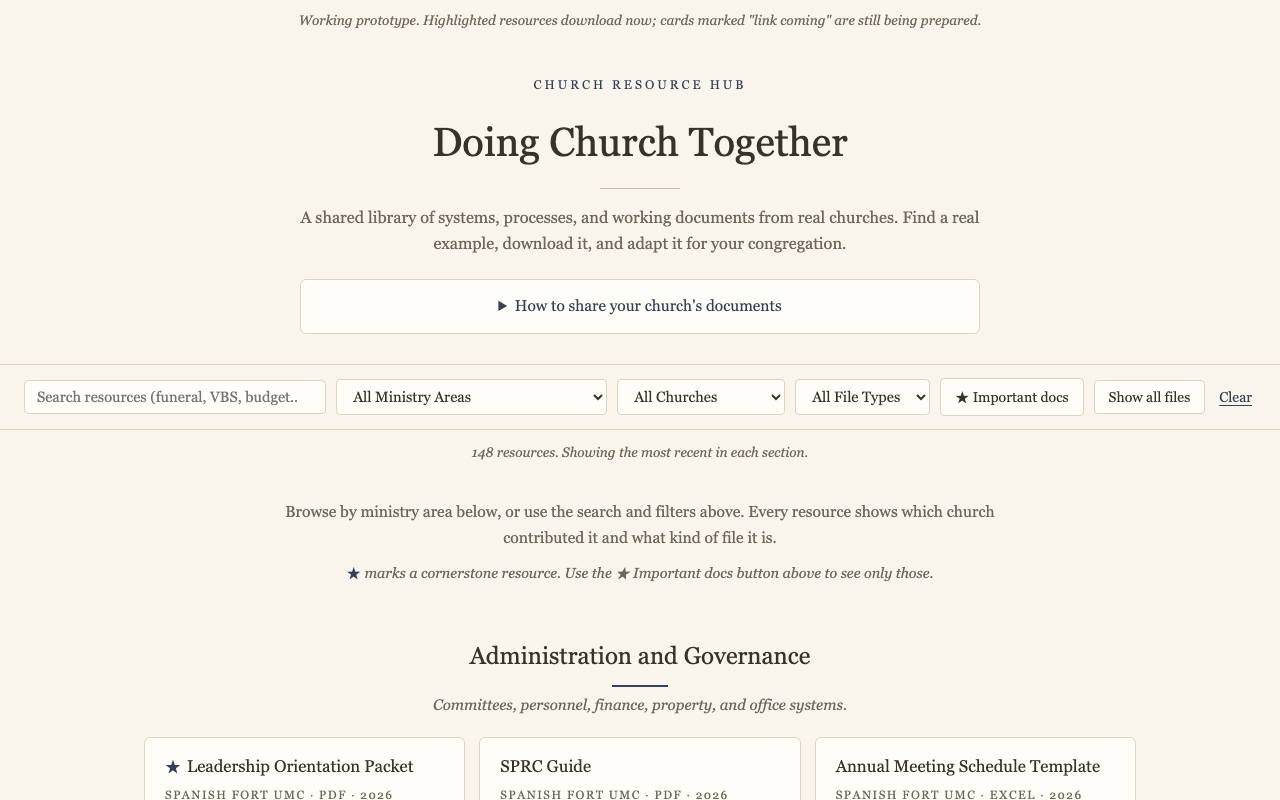
The Church Resource Hub: the search bar, ministry-area filters, and resource cards.
The Toolbox

The Church Resource Hub


A shared library of systems, processes, and working documents from real churches, nearly 150 resources across every ministry area: orientation packets and budgets, event playbooks and safety policies, frameworks and worship plans. Nothing theoretical, nothing gated; almost every card is a document a congregation actually uses, offered so yours can adapt it instead of starting from a blank page.

Where the cards come from: most hold the actual working file, uploaded as the church uses it. Some describe a process that is real but was never written down in one place; those carry an "Edited Summary" label, meaning an AI assistant first drafted the description of how it happens from the church's own records, committee minutes, pastor's notes, and reports, and the pastor then revised the write-up himself.

How to use it: search for what you need or browse by ministry area, download the file, and make it your own. Stars mark the cornerstone documents, and the contribute page lets your church add its best work to the library.

How it connects: every "Grab the tools" list in the Pastor's Handbook points to a live card here. The book tells you what the tool is for; the hub hands it to you.

Browse the Hub
The Pastor's Handbook: the contents panel on the left, with the cover and table of contents open in the reading pane.
The Map

The Pastor's Handbook


A digital field guide for leading a local church, written for first-time and newly appointed pastors, Course of Study students, and workshop cohorts. Thirty-four chapters across eight parts walk the whole job, from the pastor's own call and inner life through worship, care, discipleship, missions, money, and leading change, each chapter teaching one piece of the work in plain language, telling a true story of how it went at a real church, and ending with concrete steps.

How it was written: the frameworks in it are one pastor's own, worked out over fifteen years of doing the job, and the content of every chapter came out of real experience and personal documents. An AI assistant drafted against the lived experience and personal writings to create a steady structure across all thirty-four chapters. This document is created by Claude out of hundreds of thousands of words written over fifteen years regarding practical ministry. Each chapter has been read and revised for accuracy.

How to use it: read it straight through or jump to the chapter for the season you are in, take its one next step this week, and follow its links to the exact documents you need.

How it connects: the handbook is the map to the hub's toolbox. Where the hub gives you the document, the book gives you the path, and its running case study is the same congregation whose files fill the library.

Read the Handbook
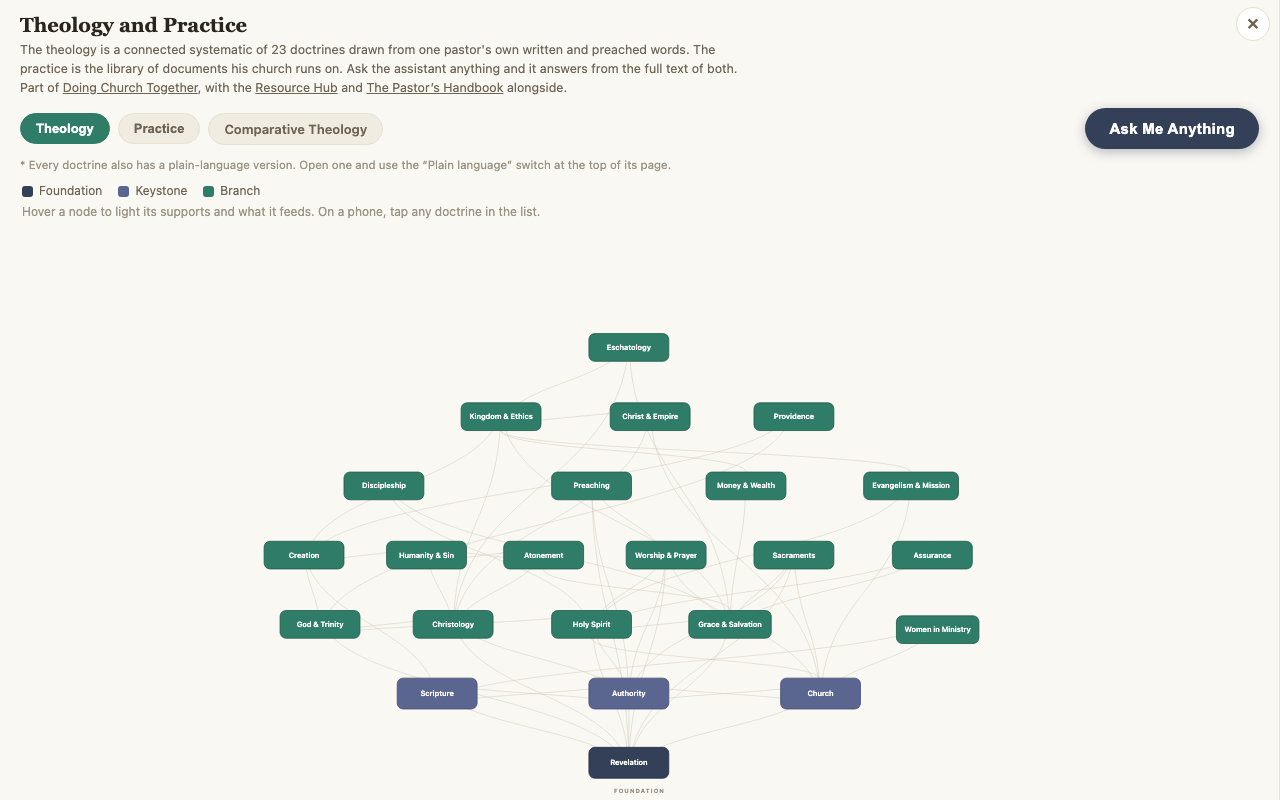
Theology and Practice: the doctrine map with an Ask Me Anything assistant.
The Thinking

One pastor's way of working through theology and practice


This began as one pastor's file drawer: almost twenty years of sermons, ordination papers, Bible studies, and weekly notes to a congregation. Gathered in one place, those pages turned out to hold a connected theology, so it was mapped: twenty-three doctrines, each hanging by a visible line from the foundation it depends on, alongside the sermons themselves and the practice library his church runs on. It is not offered as the definitive word on anything. It is a real-world example of a pastor working out his theology in the open, in a visual, connected way, and an assistant answers your questions from the full text of it, anchored in what was actually written and preached rather than in the internet's guesses.

How to use it: click any doctrine to read its full treatment, in the scholar's version or the plain-language one, and follow the connections from one locus into the next, or simply ask the assistant a question, about grace, about Scripture, about women in ministry, and read the sources it answers from.

How it connects: the practice in the hub and the handbook stands on this thinking. If the book ever makes you ask why behind a how, this is where the why lives.

Explore the Theology
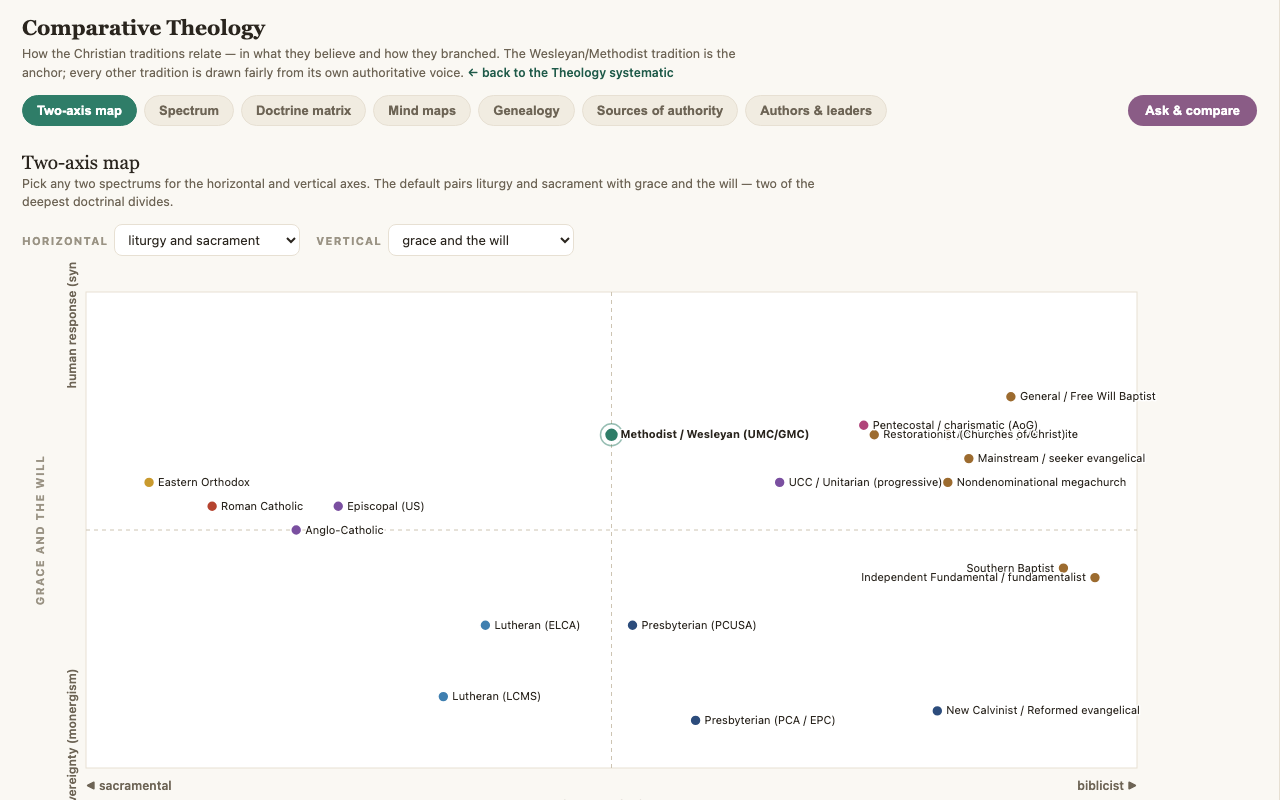
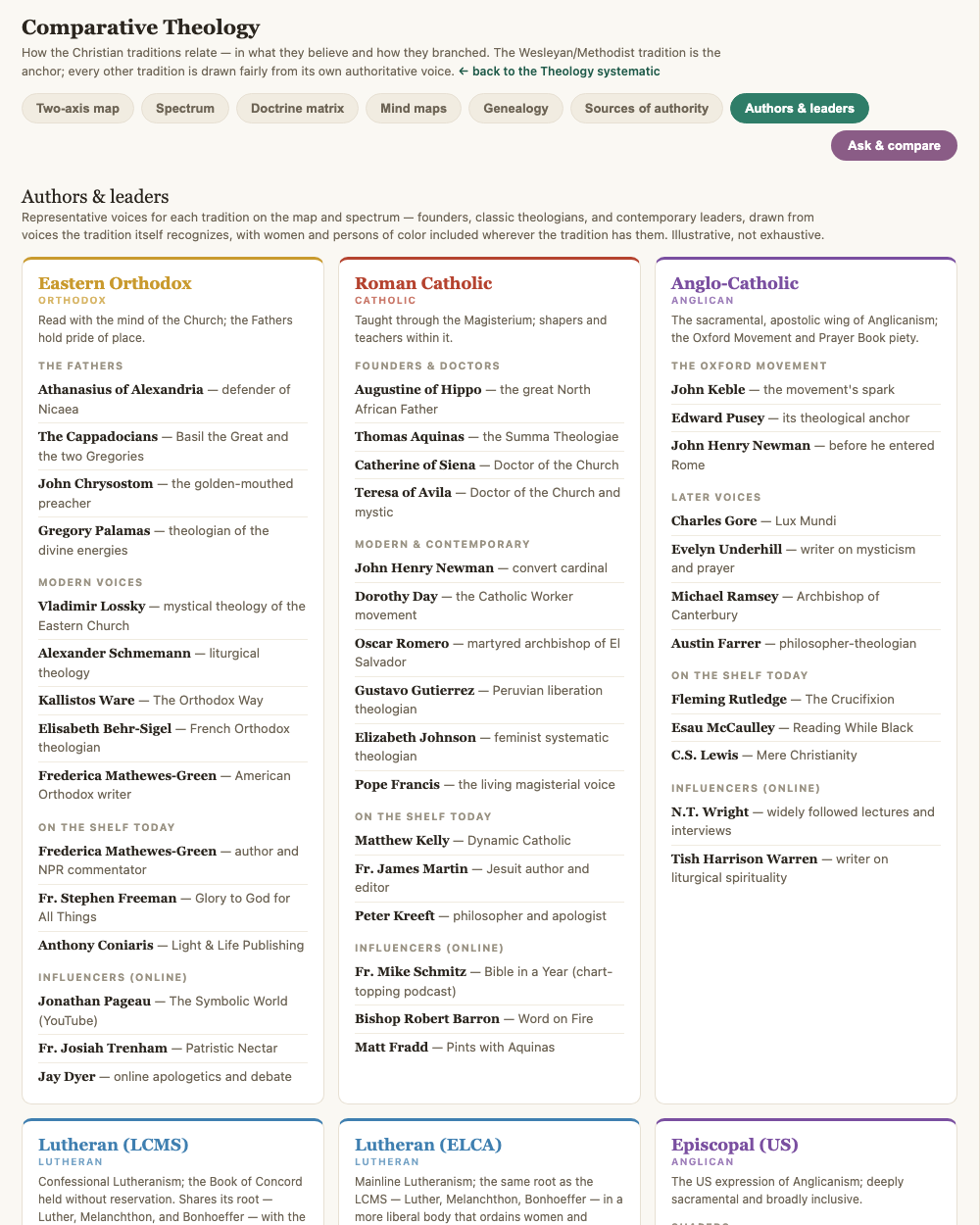
Comparative Theology: the traditions plotted on a two-axis map, with tabs for the spectrum, the doctrine matrix, the genealogy, and authors and leaders.
The Compass

Comparative Theology


A companion to the theology that sets one pastor's Wesleyan convictions inside the wider family of Christian traditions. Compare what the churches believe, doctrine by doctrine, and trace how they branched across two thousand years, from the early church to the many streams alive today. Every tradition is drawn fairly from its own voice, so the differences stay honest and the common ground stays real.

How to use it: pick any two questions and watch the traditions sort themselves across the map, read a single doctrine straight across the families, or open a tradition to meet its founders and the authors you would find on the shelf today. A built-in assistant compares any two traditions for you and answers from the sources.

How it connects: the Theology gives you one pastor's own systematic, and this sets that systematic in the wider landscape. You can see where your own congregation stands, and understand the neighbors you share a town and a mission with.

Open Comparative Theology
One Desk, Four Doors

How they fit together

Start anywhere. The four resources grew out of one congregation's rebuild, and they were built to hand ministry on rather than hold it close, because nothing faithful should have to be invented twice.

Grab a tool

The Hub

You need a working document today, a policy, a playbook, a packet. Search the library, download it, and adapt it for your congregation.

Learn the work

The Handbook

You need to understand the job the documents serve. Read the chapter for your season, take its next step, and grab its tools from the hub as you go.

See the ground

Theology and Practice

You want the thinking underneath the practice. Walk the map from its foundation upward, or ask a question and follow the answer to its sources.

Find your bearings

Comparative Theology

You want to know where your tradition stands among the others. Compare the churches on what they believe and how they branched, and find the common ground you already share.